
Financial Planning


This isn’t a Budget night announcement anymore. The Treasury Laws Amendment (Tax Reform No. 1) Bill 2026 received Royal Assent on 26 June 2026, and the reform is now law. The headline mechanism, the switch from the 50% discount to indexation plus a 30% minimum tax, is locked in with some technical detail to follow.
The changes apply across the board, to property, shares, managed funds and most other assets held by individuals, trusts and partnerships. If you hold shares or managed funds alongside an investment property, your entire portfolio is in scope, not just the real estate. The one major carve-out is superannuation, which keeps its existing one-third discount untouched.
This is a forward-looking change, not a retrospective one. Gains accruing before 1 July 2027 keep the 50% discount, with gains after that date falling under the new rules. In practice, this means valuing assets as at 1 July 2027 to split any future gain into a “before” and “after” portion becomes critical.
Some things stay exactly as they are. The main residence exemption is untouched. The 12-month ownership test also carries over unchanged. It still gates eligibility for concessional treatment, just for indexation now rather than the 50% discount. And for clients who hold investments through a company, nothing changes at all because companies were never eligible for the 50% discount.
Sarah bought a portfolio of ASX-listed shares in 2010 for $400,000 and sells in 2030 for $1,250,000. Because she’s holding the shares across the 1 July 2027 line, her tax calculation now has to be done in two parts rather than one.
Unlike property or unlisted assets, valuing listed shares at the transition date is straightforward: the market simply provides a quoted price. At 1 July 2027, Sarah’s portfolio is worth $1,100,000, splitting her gain into a pre- and post-transition portion, shown below.
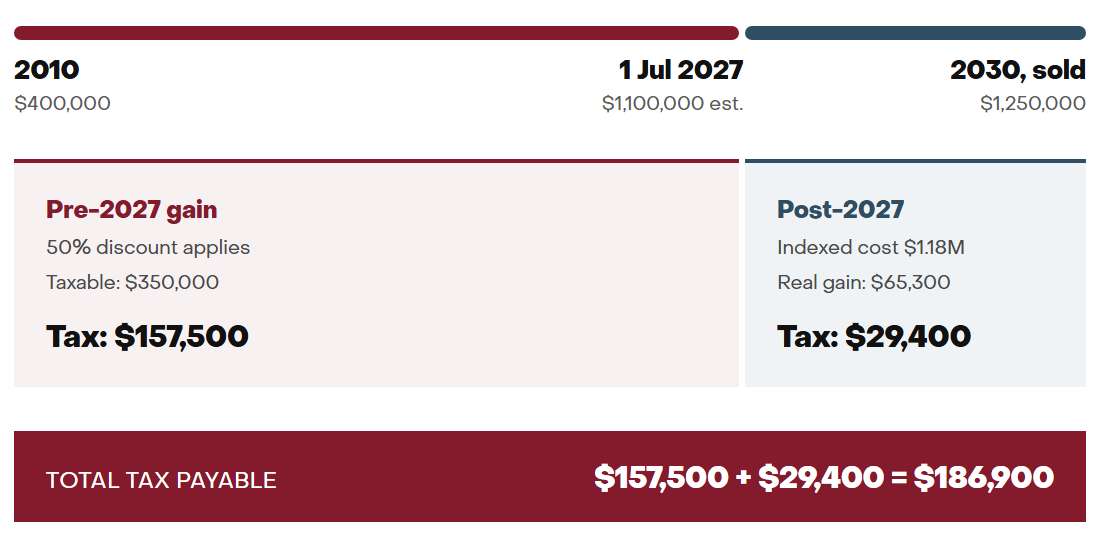
The 1 July 2027 valuation and the indexed cost base above are estimates based on a CPI assumption of around 2.5% a year. Actual figures will depend on CPI and the ATO’s finalised valuation methodology at the time of sale.
Because Sarah’s marginal rate is already 45%, above the 30% floor, the minimum tax doesn’t add anything on top; she pays tax at her normal rate either way.
For comparison, if the old 50% discount had still applied to her entire gain, Sarah would have paid roughly $191,250, only around $4,350 more than the $186,900 she pays under the new split rules. In her case, the change makes little practical difference. That won’t be true for everyone, so it’s worth running your own numbers with your adviser rather than assuming either way.
We’ve used a share portfolio here deliberately. This reform reaches every asset class, and the same split logic applies whether you’re holding shares, managed funds, or a business interest.
The new rules only apply to gains from 1 July 2027. There’s no benefit in selling early to lock in the old discount, and a rushed decision can easily cost more than it saves.
It matters most for assets you plan to hold across the 1 July 2027 line, especially anything with a large unrealised gain or Estimate what the asset will likely be worth at that date, and what that means for tax whenever you eventually sell.
Good records matter more under the new rules, not less. Indexed acquisition costs and improvements reduce the taxable gain, so keep that documentation in order. A supportable valuation at 1 July 2027 may also be needed to split the pre- and post-2027 portions of any gain, and an adviser can help with that.
This alone isn’t a reason to sell. But if you’re holding assets into the new regime, it’s worth understanding what that will look like.
Speak with your adviser about how the transition could affect your portfolio.
This document was prepared by Evans and Partners Pty Ltd (ABN 85 125 338 785, AFSL 318075) (“Evans and Partners”). Evans and Partners is a wholly owned subsidiary of E&P Financial Group Limited (ABN 54 609 913 457) (E&P Financial Group).
The information may contain general advice or is factual information and was prepared without taking into account your objectives, financial situation or needs. Before acting on any advice, you should consider whether the advice is appropriate to you. Seeking professional personal advice is always highly recommended. Where a particular financial product has been referred to, you should obtain a copy of the relevant product disclosure statement or other offer document before making any decision in relation to the financial product. Past performance is not a reliable indicator of future performance.
The information may contain statements, opinions, projections, forecasts and other material (forward looking statements), based on various assumptions. Those assumptions may or may not prove to be correct. Neither E&P Financial Group, its related entities, officers, employees, agents, advisers nor any other person make any representation as to the accuracy or likelihood of fulfilment of the forward looking statements or any of the assumptions upon which they are based. While the information provided is believed to be accurate E&P Financial Group takes no responsibility in reliance upon this information.
The information provided is correct at the time of writing or recording and is subject to change due to changes in legislation. The application and impact of laws can vary widely based on the specific facts involved. Given the changing nature of laws, rules and regulations, there may be delays, omissions or inaccuracies in information contained.
Any taxation information contained in this communication is a general statement and should only be used as a guide. It does not constitute taxation advice and before making any decisions, you should seek professional taxation advice on any taxation matters where applicable.
The Financial Services Guide of Evans and Partners contains important information about the services we offer, how we and our associates are paid, and any potential conflicts of interest that we may have. A copy of the Financial Services Guide can be found at www.eandp.com.au. Please let us know if you would like to receive a hard copy free of charge.

Begin a conversation with an adviser who will help you achieve your wealth goals.
Fill out this expression of interest and you will be alerted when applications open later in the year.
Begin a conversation with an accountant who can help you with your self-managed super fund.
Begin a conversation with an adviser who will help you achieve your wealth goals.
Subscribe to get Insights and Ideas about trends shaping markets, industries and the economy delivered to your inbox.
Reach out and start a conversation with one of our experienced team.
Begin a conversation with one of our advisers who will help you achieve your wealth goals.
You can search for an adviser by location or name. Alternatively contact us and we will help you find an adviser to realise your goals.