
Roadmap


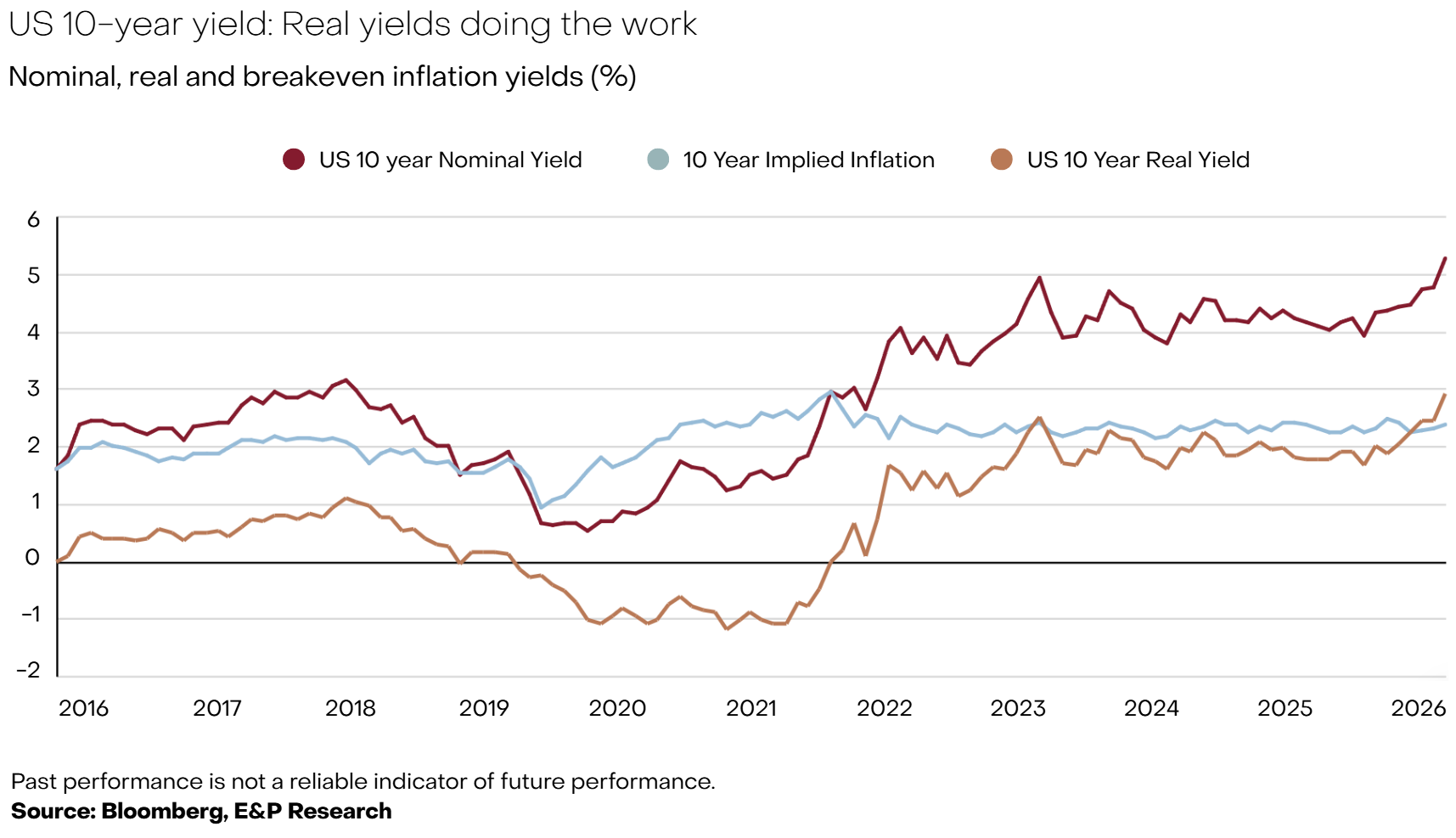
The sell-off is not primarily an inflation story. As the chart shows, most of the rise in the US 10-year yield has come from real yields, while inflation expectations have barely moved. Four forces explain why investors demand a higher real return:
Australia has felt these forces more acutely, and its yields sit uneasily with the economy beneath them. Growth is soft, unemployment is edging higher, housing is weakening and consumers are cautious. The United States, by contrast, has firmer momentum.
The explanation is domestic inflation. At 4.0% in August, it is well above the RBA’s target, reflecting capacity constraints rather than strong demand. Weak productivity limits how quickly the economy can grow without adding to prices, and sustained government spending has added to demand for scarce labour.
This leaves interest rates doing most of the work, and households with mostly variable rate mortgages are sensitive to them. In our view, yields reflect tighter domestic policy and global spillovers more than domestic strength, which should limit how far rates can rise.
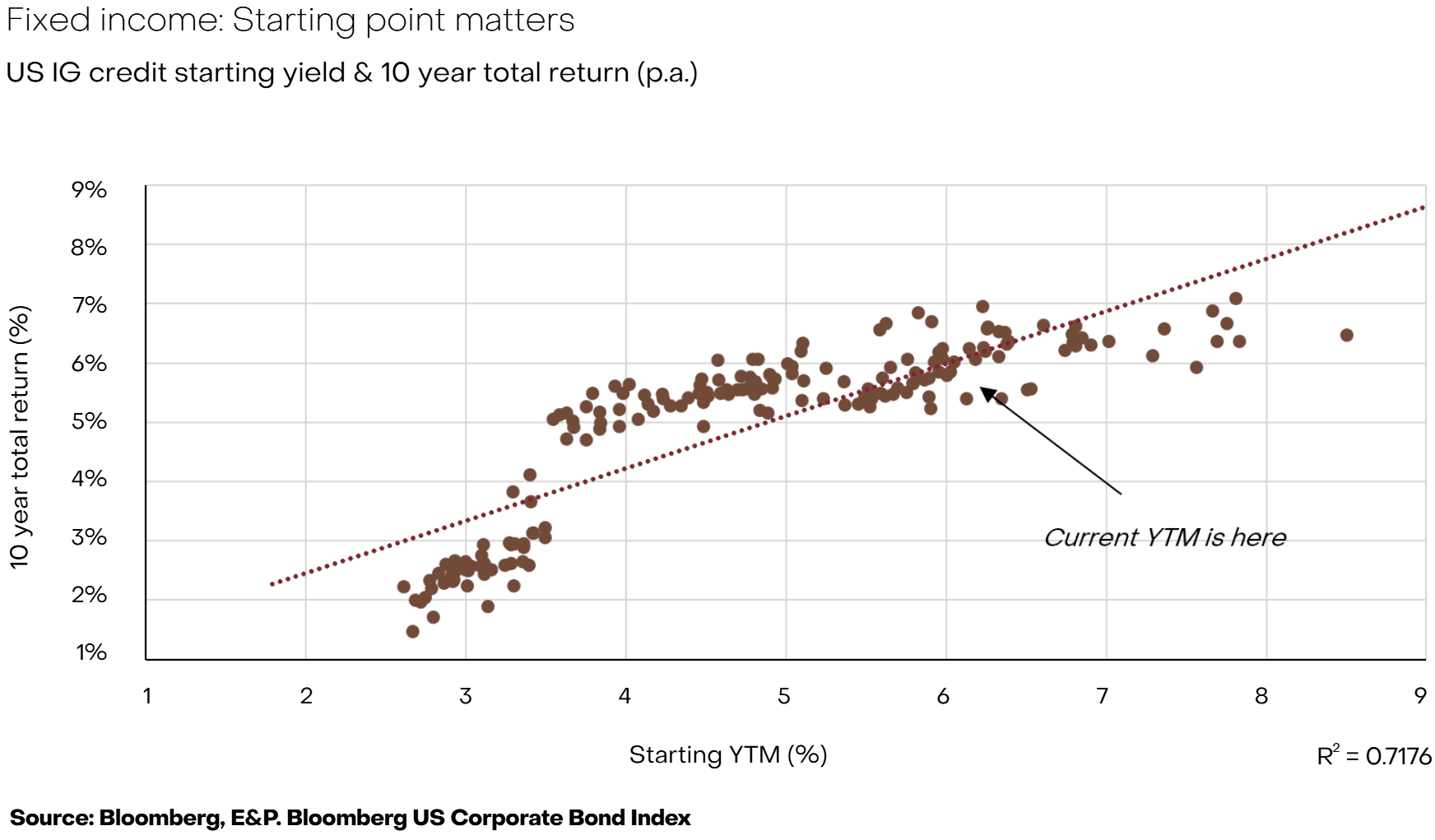
For new investors, the sell-off has also lifted the yield on offer. That matters because the yield at purchase has historically been among the strongest guides to future returns.
Credit adds another dynamic to the return equation. A spread over government bond yields, providing income and a buffer if yields rise further. A soft economy might seem at odds with taking credit risk, but we distinguish between a slowdown and a recession. We expect policy rates to peak, and business investment, firm commodity prices and relatively healthy public finances should keep recession risk low. Broadly, spreads are priced reasonably for that outcome. Some sectors, such as banks and property, could see risk premiums widen if conditions deteriorate, so selectivity matters. Our preference is for higher quality issuers and a mix of fixed and floating rate exposure.
Given this starting point, we are continuing to advocate for building positions in interest rate securities – we have an ‘overweight’ asset allocation recommendation. The opportunity set spans global and domestic issuers. In global markets we prefer corporate issuers, while in Australia we favour a combination of government and corporate bonds, with fixed rate exposure growing in appeal as the soft economy limits how much higher rates can go.
This article was prepared by Evans and Partners Pty Ltd (ABN 85 125 338 785, AFSL 318075) (“Evans and Partners”). Evans and Partners is a wholly owned subsidiary of E&P Financial Group Limited (ABN 54 609 913 457) (E&P Financial Group) and related bodies corporate
The information may contain general advice or is factual information and was prepared without taking into account your objectives, financial situation or needs. Before acting on any advice, you should consider whether the advice is appropriate to you. Seeking professional personal advice is always highly recommended. Where a particular financial product has been referred to, you should obtain a copy of the relevant product disclosure statement or other offer document before making any decision in relation to the financial product. Past performance is not a reliable indicator of future performance.
The information may contain statements, opinions, projections, forecasts and other material (forward looking statements), based on various assumptions. Those assumptions may or may not prove to be correct. Neither E&P Financial Group, its related entities, officers, employees, agents, advisers nor any other person make any representation as to the accuracy or likelihood of fulfilment of the forward looking statements or any of the assumptions upon which they are based. While the information provided is believed to be accurate E&P Financial Group takes no responsibility in reliance upon this information.
The information provided is correct at the time of writing or recording and is subject to change due to changes in legislation. The application and impact of laws can vary widely based on the specific facts involved. Given the changing nature of laws, rules and regulations, there may be delays, omissions or inaccuracies in information contained.
Any taxation information contained in this communication is a general statement and should only be used as a guide. It does not constitute taxation advice and before making any decisions, you should seek professional taxation advice on any taxation matters where applicable.
The Financial Services Guide of Evans and Partners contains important information about the services we offer, how we and our associates are paid, and any potential conflicts of interest that we may have. A copy of the Financial Services Guide can be found at www.eandp.com.au. Please let us know if you would like to receive a hard copy free of charge.



Begin a conversation with an adviser who will help you achieve your wealth goals.
Fill out this expression of interest and you will be alerted when applications open later in the year.
Begin a conversation with an accountant who can help you with your self-managed super fund.
Begin a conversation with an adviser who will help you achieve your wealth goals.
Subscribe to get Insights and Ideas about trends shaping markets, industries and the economy delivered to your inbox.
Reach out and start a conversation with one of our experienced team.
Begin a conversation with one of our advisers who will help you achieve your wealth goals.
You can search for an adviser by location or name. Alternatively contact us and we will help you find an adviser to realise your goals.