

Roadmap


Understandably, many people want to stay in their own home for as long as possible. As care needs increase, families often need to compare the cost and practicality of care at home with residential care.
Affordability is only part of that decision. The more useful question is how each option affects cash flow, capital, flexibility and the level of care available. The lowest-cost option is not automatically the right one.
Support at Home, which replaced Home Care Packages, subsidises approved services based on an individual’s assessed needs. What an individual contributes depends on the type of service and their financial circumstances. Clinical care is fully funded. For independence and everyday living services, a part pensioner might pay around 16 per cent and around a third respectively, while a self-funded retiree pays 50 per cent and 80 per cent.
Government funding may leave a gap between what is subsidised and the total cost of staying at home. Many families choose to fund additional support privately, beyond their funded budget, such as extra nursing hours, cleaning, gardening or home modifications.
That gap may widen as care needs grow.
For new entrants, residential care brings two separate sets of costs.
The first is the ongoing cost of care and living. Clients pay a basic daily fee, with means-tested contributions on top towards everyday living costs and, for those with greater means, non-clinical care. Clients may also choose additional services or a higher standard of everyday living, which carries an extra fee.
The second is accommodation. This can be paid as a refundable accommodation deposit (RAD), a daily accommodation payment (DAP) or a combination of both. Under the current arrangements, a provider deducts 2 per cent a year from the deposit for up to five years. The amount returned may therefore be less than the amount paid.
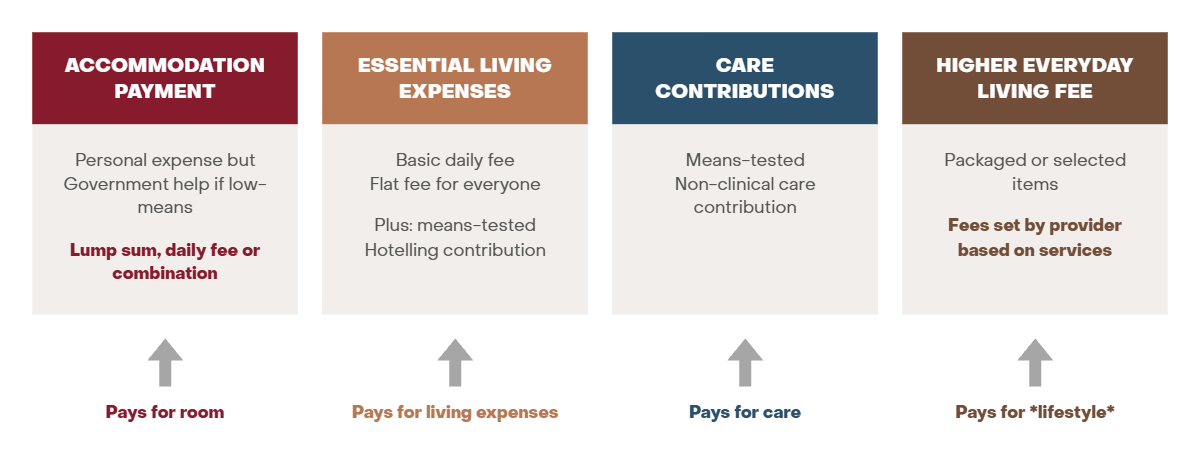
The key difference is the capital commitment. Even where ongoing costs are manageable, entering residential care may require a substantial amount of capital to be directed towards accommodation.
Consider Graham and Joan. Graham is 84 and Joan is 81. They own their home, valued at about $1.3 million, and Graham continues to live there independently. Outside the home, they hold about $750,000 in assessable assets, the assets that count towards means testing. Following a fall, Joan’s mobility is declining. She has been assessed as needing a relatively high level of care and approved for residential care. The figures are illustrative.
If Joan stays at home, her contributions towards Support at Home may be around $8,500 a year. That is the lower annual cost, at least initially. The comparison may shift if Joan needs additional privately funded care. It may also come under strain if Graham, at 84, increasingly takes on the role of carer.
If Joan moves into residential care, ongoing fees may be around $33,000 a year before accommodation. A $600,000 room price would also absorb most of the $750,000 they hold outside the home. However, residential care may provide a more comprehensive level of care and reduce Graham’s responsibilities as carer.
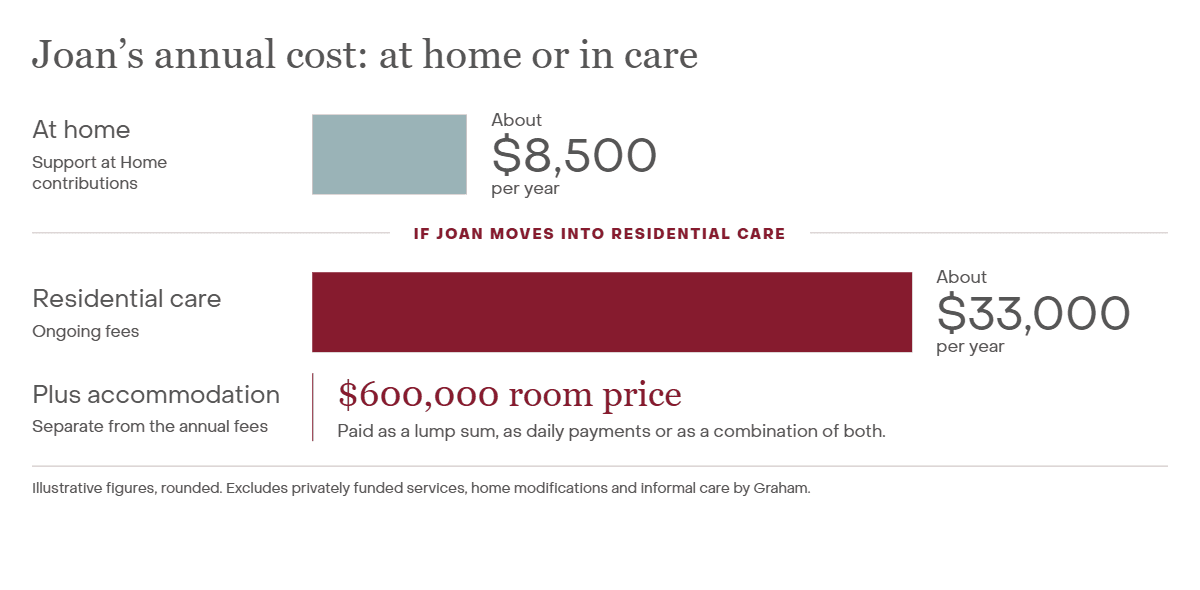
On these numbers, care at home looks cheaper. The better test is what it costs to provide Joan with an appropriate and sustainable level of care under each option, and what that means for the family’s capital, cash flow and flexibility.
Aged care decisions rarely sit in isolation. The surrounding questions often matter as much as the fees themselves.
Families may need to consider whether the family home should be retained, particularly where a spouse will continue to live there, and how that decision affects liquidity and future care needs. They may also weigh how much capital should remain accessible if significant funds could later be required for the second partner’s care. Estate planning may influence which assets are retained or sold.
Each of these decisions affects the others. Aged care is therefore best considered as part of the family’s broader wealth strategy.
Comparing annual costs is useful, but it does not tell a family which option is right. Care needs, lifestyle, family capacity, liquidity and future flexibility all matter.
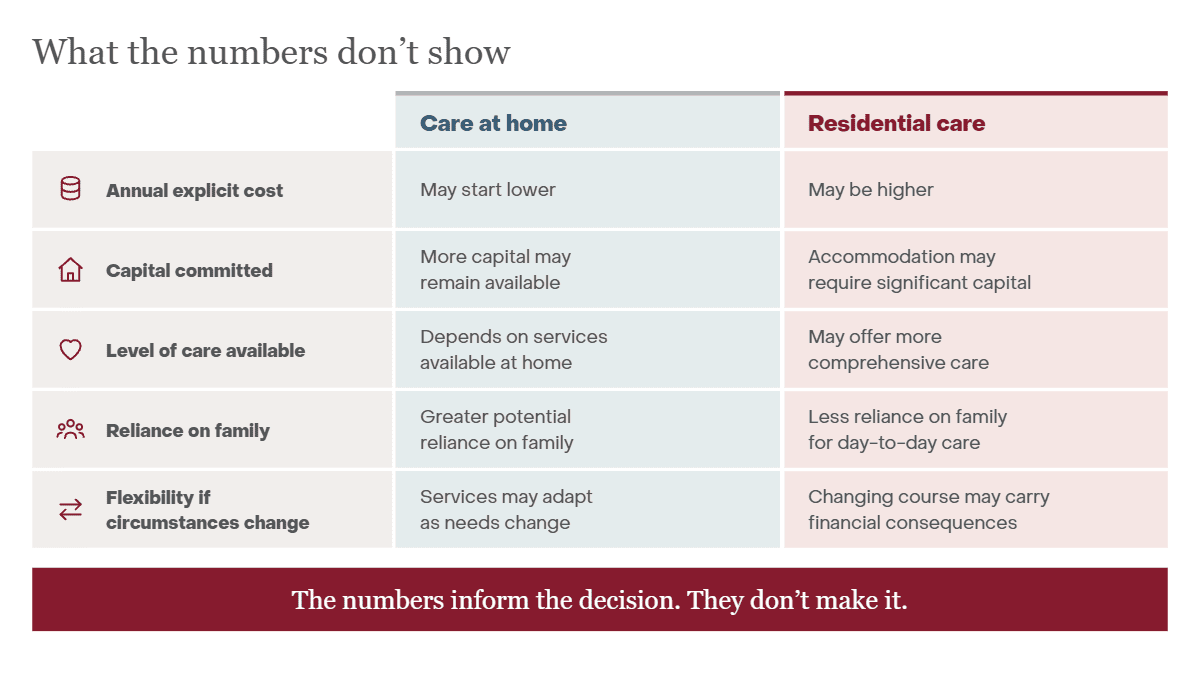
Planning before care becomes urgent gives families more time to understand the options and model the financial consequences. Decisions can then reflect both care needs and broader financial objectives. Clients considering aged care may wish to speak with a specialist aged care adviser to explore how these considerations apply to their situation.
This article was prepared by Evans and Partners Pty Ltd (ABN 85 125 338 785, AFSL 318075) (“Evans and Partners”). Evans and Partners is a wholly owned subsidiary of E&P Financial Group Limited (ABN 54 609 913 457) (E&P Financial Group) and related bodies corporate.
The information may contain general advice or is factual information and was prepared without taking into account your objectives, financial situation or needs. Before acting on any advice, you should consider whether the advice is appropriate to you. Seeking professional personal advice is always highly recommended. Where a particular financial product has been referred to, you should obtain a copy of the relevant product disclosure statement or other offer document before making any decision in relation to the financial product. Past performance is not a reliable indicator of future performance.
The information may contain statements, opinions, projections, forecasts and other material (forward looking statements), based on various assumptions. Those assumptions may or may not prove to be correct. Neither E&P Financial Group, its related entities, officers, employees, agents, advisers nor any other person make any representation as to the accuracy or likelihood of fulfilment of the forward looking statements or any of the assumptions upon which they are based. While the information provided is believed to be accurate E&P Financial Group takes no responsibility in reliance upon this information.
The information provided is correct at the time of writing or recording and is subject to change due to changes in legislation. The application and impact of laws can vary widely based on the specific facts involved. Given the changing nature of laws, rules and regulations, there may be delays, omissions or inaccuracies in information contained.
Any taxation information contained in this communication is a general statement and should only be used as a guide. It does not constitute taxation advice and before making any decisions, you should seek professional taxation advice on any taxation matters where applicable.
The Financial Services Guide of Evans and Partners contains important information about the services we offer, how we and our associates are paid, and any potential conflicts of interest that we may have. A copy of the Financial Services Guide can be found at www.eandp.com.au. Please let us know if you would like to receive a hard copy free of charge.

Begin a conversation with an adviser who will help you achieve your wealth goals.
Fill out this expression of interest and you will be alerted when applications open later in the year.
Begin a conversation with an accountant who can help you with your self-managed super fund.
Begin a conversation with an adviser who will help you achieve your wealth goals.
Subscribe to get Insights and Ideas about trends shaping markets, industries and the economy delivered to your inbox.
Reach out and start a conversation with one of our experienced team.
Begin a conversation with one of our advisers who will help you achieve your wealth goals.
You can search for an adviser by location or name. Alternatively contact us and we will help you find an adviser to realise your goals.