
Roadmap


From 1 July 2028, a 30% top-up tax may apply at the trustee level to the income of affected discretionary trusts. Because individual beneficiaries would receive only a non-refundable credit, the measure has most effect where income would otherwise be taxed below 30%. Fixed trusts, superannuation funds, charitable trusts and deceased estates are excluded, as is income of existing genuine testamentary trusts.
Trusts distributing mainly to individuals taxed at or above 30% may see little change, but trustees relying on lower-taxed or corporate beneficiaries would need to consider three broad paths.
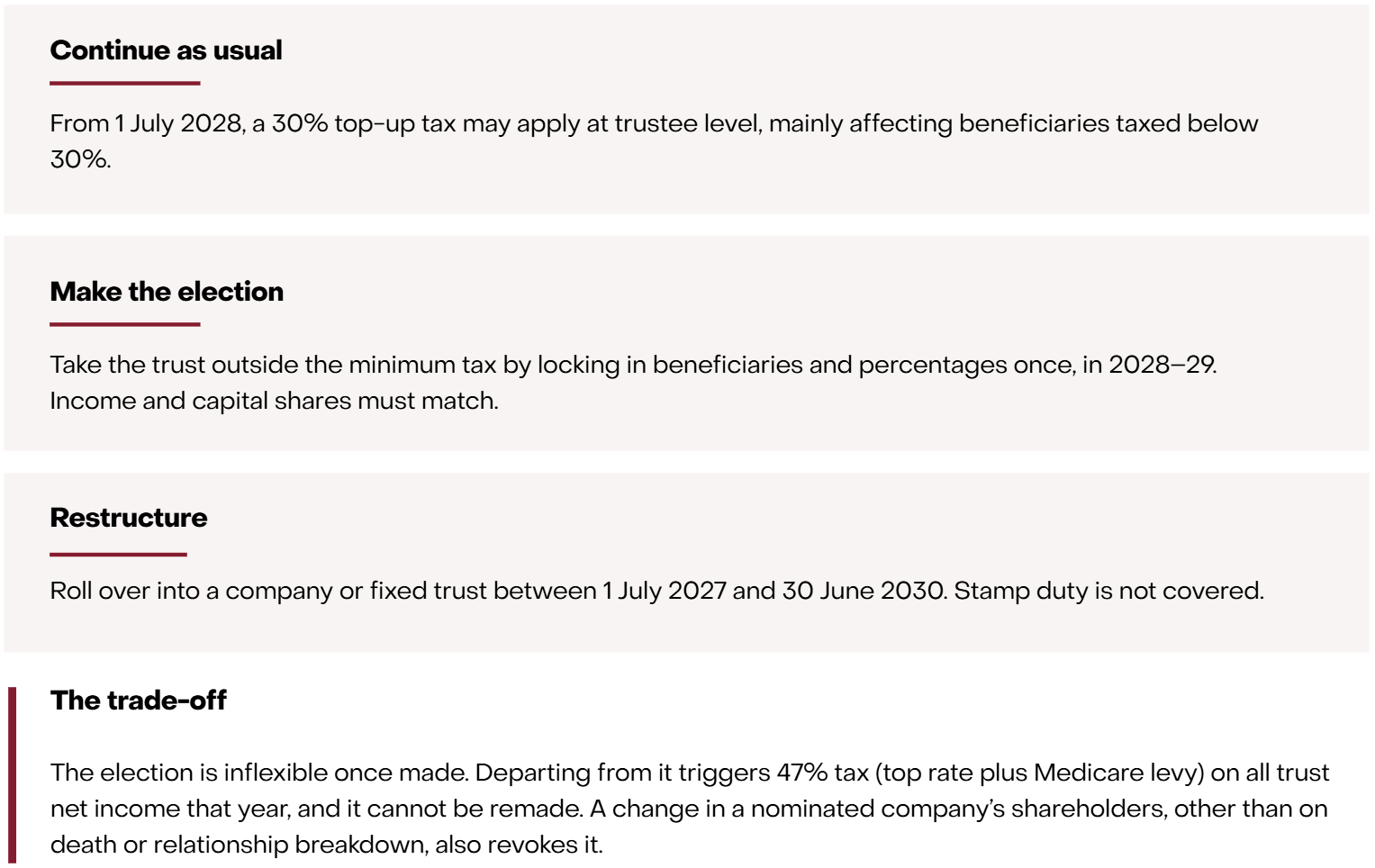
The starting point is whether the trust needs to change at all, as preserving flexibility may outweigh a small tax exposure where beneficiaries are already taxed at or above 30%.
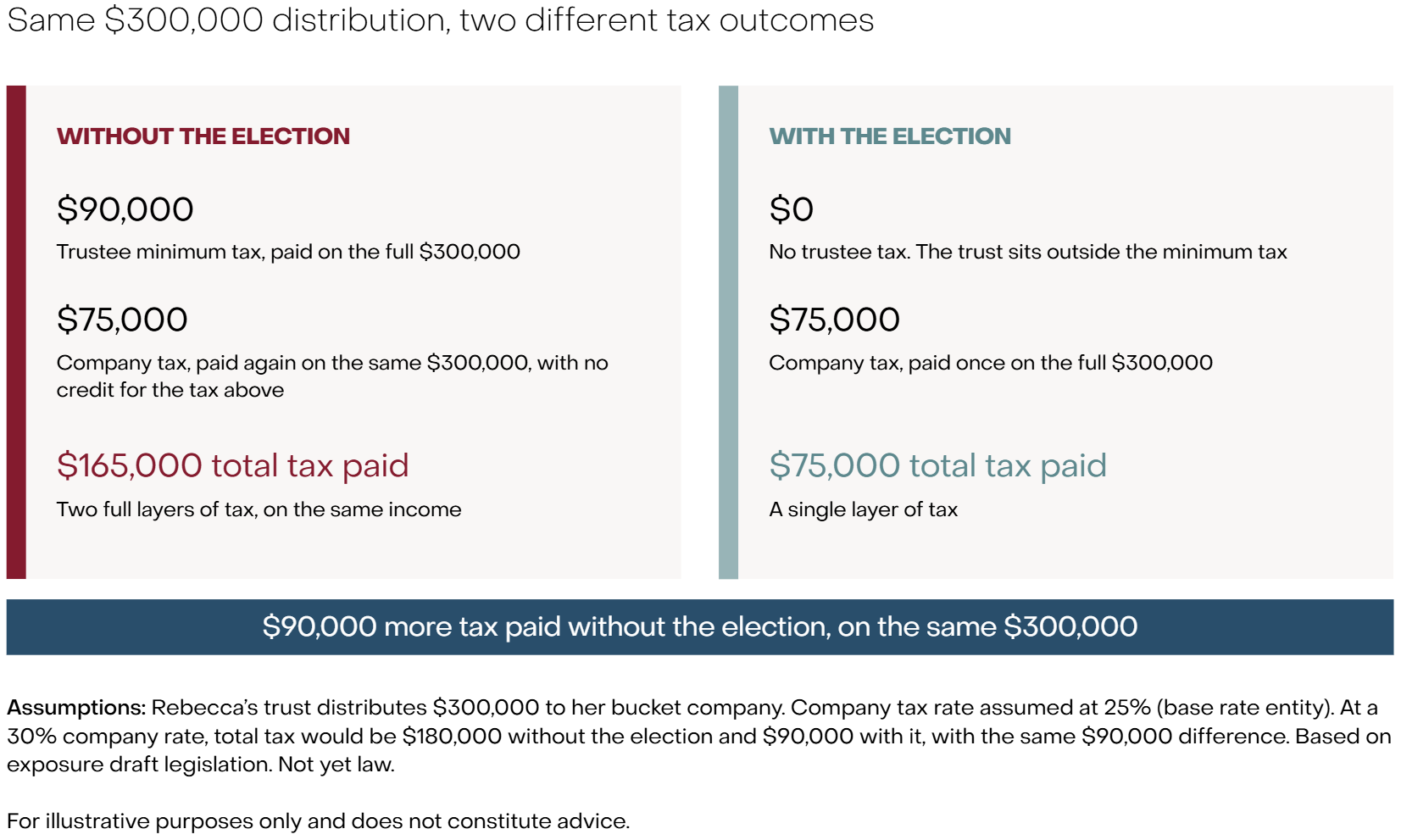
For example, Rebecca’s discretionary trust distributes to a bucket company each year, so continuing as usual would see that income taxed twice, with no credit in the company’s hands for the tax already paid. Making the election would leave the company taxed only once, although the trust’s distributions to the company would be locked in and could no longer vary from year to year. Restructuring would result in the trust’s assets moving out of the regime altogether, but the stamp duty payable upon transfer may outweigh the tax saved.
The election is a one-off decision, available only during the 2028–29 income year. Nominating a bucket company depends on its shareholders having fixed rights to income and capital, so a company whose directors can choose which share class receives dividends may not qualify, an arrangement that is common in many family trust structures.
Restructuring may suit families looking for a more permanent answer, with assets moved into a company or fixed trust and rollover relief covering income tax, including capital gains tax, but not state and territory stamp duty. The relief may also be reversed if the new structure becomes discretionary within around four years. The Government has said the election is expected to avoid stamp duty, although some commentators expect the states may take a different view.
Importantly, the two options are mutually exclusive, and choosing the restructure rules out the election even if the restructure is never completed in practice.
No single path suits every trust. The right choice depends on how the trust has been used historically and whether annual discretion has been genuine or a formality.
Clients with discretionary trusts, particularly those with bucket company beneficiaries, may wish to begin reviewing their position now. Talk to your adviser about how the draft measure could apply to your structure, and which path deserves closer attention before the rules are settled.
This article was prepared by Evans and Partners Pty Ltd (ABN 85 125 338 785, AFSL 318075) (“Evans and Partners”). Evans and Partners is a wholly owned subsidiary of E&P Financial Group Limited (ABN 54 609 913 457) (E&P Financial Group) and related bodies corporate
The information may contain general advice or is factual information and was prepared without taking into account your objectives, financial situation or needs. Before acting on any advice, you should consider whether the advice is appropriate to you. Seeking professional personal advice is always highly recommended. Where a particular financial product has been referred to, you should obtain a copy of the relevant product disclosure statement or other offer document before making any decision in relation to the financial product. Past performance is not a reliable indicator of future performance.
The information may contain statements, opinions, projections, forecasts and other material (forward looking statements), based on various assumptions. Those assumptions may or may not prove to be correct. Neither E&P Financial Group, its related entities, officers, employees, agents, advisers nor any other person make any representation as to the accuracy or likelihood of fulfilment of the forward looking statements or any of the assumptions upon which they are based. While the information provided is believed to be accurate E&P Financial Group takes no responsibility in reliance upon this information.
The information provided is correct at the time of writing or recording and is subject to change due to changes in legislation. The application and impact of laws can vary widely based on the specific facts involved. Given the changing nature of laws, rules and regulations, there may be delays, omissions or inaccuracies in information contained.
Any taxation information contained in this communication is a general statement and should only be used as a guide. It does not constitute taxation advice and before making any decisions, you should seek professional taxation advice on any taxation matters where applicable.
The Financial Services Guide of Evans and Partners contains important information about the services we offer, how we and our associates are paid, and any potential conflicts of interest that we may have. A copy of the Financial Services Guide can be found at www.eandp.com.au. Please let us know if you would like to receive a hard copy free of charge.

Begin a conversation with an adviser who will help you achieve your wealth goals.
Fill out this expression of interest and you will be alerted when applications open later in the year.
Begin a conversation with an accountant who can help you with your self-managed super fund.
Begin a conversation with an adviser who will help you achieve your wealth goals.
Subscribe to get Insights and Ideas about trends shaping markets, industries and the economy delivered to your inbox.
Reach out and start a conversation with one of our experienced team.
Begin a conversation with one of our advisers who will help you achieve your wealth goals.
You can search for an adviser by location or name. Alternatively contact us and we will help you find an adviser to realise your goals.